
More virus, less disease?
Read the full article on ScienceDirect
Bornaviruses are enveloped, negative strand RNA viruses, that infect nerves. Our research group is interested in avian health, thus developing a vaccine for parrot bornavirus is a goal. In this study we prepared and tested a recombinant protein vaccine. When vaccinated and unvaccinated birds were challenged, the majority of vaccinated birds remained healthy, while the unvaccinated birds developed severe disease. Thus, it appeared that we had a successful vaccine. However, when we tested the vaccinated birds, they had high levels of virus in their tissues (but no macroscopic or microscopic indications of disease). We hypothesized that the vaccine had changed the type of immune response mounted by the birds, perhaps by suppressing responses that would damage infected neurons. A group of unvaccinated birds was treated with a cyclosporine A (a suppressor of T-cell responses) and we saw the same result: infected birds had no disease despite high levels of virus, clearly implicating immune responses in disease development.
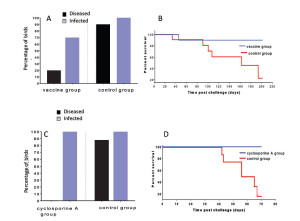
Results of vaccine trial (panels A, B) and cyclosporine A trial (panels C, D). Vaccinated birds survived challenge with very few signs of disease. However, as assessed by PCR, their tissues contained high levels of virus. Cyclosporine A treatment (panels C and D) gave similar results indicating that parrot bornaviral disease is immune-mediated.
The authors of this research are members of a multidisciplinary team interested in avian health. As parrot bornaviral disease is a major killer of captive-bred macaws, vaccine development is a desired goal. However, based on published studies of a rodent bornavirus, we knew that immune responses to bornaviruses could be damaging rather than helpful. When we planned this study some of us predicted that a simple recombinant protein vaccine could protect against infection. Others predicted that the vaccine would not protect against infection and, in fact, would be damaging. There was a lot of discussion, but surely, one these two hypotheses were correct.
Our graduate student (S.H.) accepted the challenge set up a vaccine trial. Early results favored the ‘protection’ theory as vaccinated birds remained active and healthy after virus challenge; they had no signs of bornaviral disease. Then came the surprising (and somewhat disappointing) finding. Every bird in the study, both vaccinated and not, had evidence of high levels of virus in their tissues. Our vaccine had not kept the birds from being infected, but it had prevented DISEASE. The results disproved both initial hypotheses!
Some in the group thought that the vaccine had changed immune responses of the birds. Perhaps unvaccinated birds developed an immune-mediated disease, while in the vaccinated birds, virus replication per se was not acutely damaging. If this were a mouse model an abundance of reagents would be available. However, parrots are anything but a common animal model. A suggestion was made to treat birds with a drug to suppress T-cell responses and then challenge them with virus (lots of skepticism expressed by some of us at this idea!). But in fact, treatment with cyclosporine A produced the same results as the vaccine. The treated birds were infected and had a lot of virus in their tissues. However, they remained healthy. While our results do not explain the underlying changes in the birds’ immune responses, they do provide a path to understanding more about parrot bornaviral pathogenesis. Our results also make a great point: Virus infection and replication do not necessarily cause DISEASE.
Introducing the authors

Samer Sadeq Hameed, Schubot Exotic Bird Health Center, Texas A&M University, College of Veterinary Medicine and Biomedical Sciences, USA
About the research
Studies on immunity and immunopathogenesis of parrot bornaviral disease in cockatiels
Samer Sadeq Hameed, Jianhua Guo, Ian Tizard, H.L. Shivaprasad, SusanPayne
Virology, Volume 515, February 2018, Pages 81-91