
Read the full article on Science Direct
Equine flu is a respiratory disease of horses caused by equine influenza virus (EIV). EIV is highly contagious and can cause significant economic losses. In this manuscript we describe, for the first time, the generation of a temperature sensitive (ts) EIV live-attenuated influenza vaccine (LAIV) based on the use of reverse genetics approaches. We introduced in the polymerase complex of a contemporary EIV the mutations responsible for the ts, cold-adapted (ca) and attenuated (att) phenotype of the human LAIV (Flumist). We next used reverse genetic approaches to rescue our EIV LAIV that was safe in vivo (horses) and able to confer, after a single intranasal immunization, protection against challenge with wild-type EIV in vaccinated horses. Importantly, since our EIV LAIV was generated using reverse genetic approaches, the vaccine can be easily updated to protect against drifting or emerging strains of EIV using the safety backbone of our EIV LAIV.
Different vaccination approaches have been used to minimize EIV infections in horses. However, despite the development and commercialization of EIV vaccines for almost fifty years, EIV is still circulating and causing disease in horses. Previous studies conducted in our lab revealed that substitution of four amino acid residues in the polymerase complex of several influenza viruses for those responsible of the ts, ca and att phenotypes of the human LAIV (FluMist) results in attenuated forms of the virus able to confer protection against subsequent virus challenges. This previous data gave us the idea of using the same experimental approach to create, for the first time, a LAIV for the treatment of EIV using reverse genetic approaches. We introduced in the polymerase PB2 and PB1 subunits of EIV the mutations of the human LAIV and used reverse genetics techniques to generate our EIV LAIV. In cultured cells, our EIV LAIV replicated efficiently at permissive (33oC) temperatures, important for vaccine production, but was impaired at temperatures of 37oC to 39oC, important for its safe implementation as a LAIV. Importantly, our EIV was safe, immunogenic and able to protect, upon a single intranasal inoculation, against EIV in horses. This is the first description of a ts, ca and att EIV LAIV based on the use of reverse genetics approaches. Importantly, since our EIV LAIV was generated using reverse genetics, the vaccine can be easily updated to protect against drifting and/or emerging strains of EIV using the safety backbone of our EIV LAIV as a master donor virus (MDV) and the viral surface glycoproteins (HA and NA) of new EIV variants. We are currently using this approach for the development of a bivalent EIV LAIV for the treatment of the two clades of the EIV Florida sublineage, as recommended by the World Organization for Animal Health.
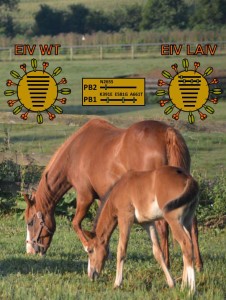
Generation of a LAIV for the treatment of EIV
To generate our EIV LAIV, we introduced in the polymerase PB2 (N265S) and PB1 (K391E, E581G, and A661T) subunits of EIV the amino acid changes responsable of the ts, ca, att phenotype of the human LAIV (FluMist). We next used reverse genetics to generate our EIV LAIV and demonstrate how the virus efficiently replicates at permissive (33oC) temperatures, important for vaccine production, but not at non-permissive (37-39oC) temperaturres, important for its safe implementation as a LAIV. Importantly, our EIV LAIV was attenuated in horses and able to induce, upon a single intranasal administration, protection against wild-type EIV. This is the first description of an EIV LAIV based on the use of reverse genetics techniques.
About the authors

Dr. Laura Rodriguez, Ph.D., is a postdoctoral fellow in the laboratory of Dr. Luis Martinez-Sobrido in The Department of Microbiology and Immunology at University of Rochester, Rochester, NY. Her research interest has been focused on the development of live-attenuated vaccines for the treatment of canine and equine influenza viruses.

Dr. Luis Martinez-Sobrido, Ph.D., is an Associate Professor in the Department of Microbiology and Immunology at University of Rochester, Rochester, NY. His graduate research focused on the study of viral replication and transcription of Respiratory Syncytial Virus (RSV) under the guidance of Dr. Jose Antonio Melero at the Instituto de Salud Carlos III in Madrid, Spain. He next conducted post-doctoral research on the molecular biology of negative stranded RNA viruses, mainly influenza A and B viruses, under the supervision of Dr. Adolfo Garcia-Sastre in the Department of Microbiology at the Icahn School of Medicine at Mount Sinai in New York, USA. His current research interest at University of Rochester focuses on the molecular biology, pathogenesis, innate immune responses and vaccine development for RNA viruses, mainly arenaviruses and influenza.
About the research
Development of a novel equine influenza virus live-attenuated vaccine
Virology, Volume 516, March 2018, Pages 76-85