
Read the full article on ScienceDirect
Viruses pack components vital for function, such as their genome, in their particle. Melbournevirus (MelV) possesses a very large particle unlike other traditional viruses, which means more interior space to pack extra viral components. The large T=309 capsid of the MelV particle is around 230 nm in diameter and built up by 3080 pseudo-hexagonal structural units (capsomers) in total. The most interesting finding in our study is that the MelV particle encapsulates a large and dense body (LDB). The size and the density of the LDB are close to those of a protein/genome complex such as the ribosome. The function of the mysterious LDB is still unclear, but the LDB could play an important role in the lifecycle of MelV, for example, as a ribonucleoprotein/RNA or DNA complex that initializes the infectious cycle.
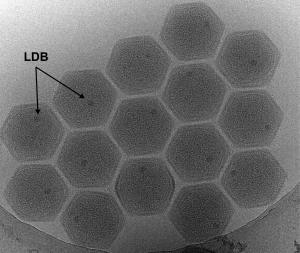
The LDB, a mysterious dense assembly in the Melbournevirus
This study is published as a part of our ambitious mission of determining the entire structure of large and giant virus particles using electron cryo-microscopy and other structural approaches. Since the discovery of the amoebal giant icosahedral Mimivirus, many new large and giant amoebal viruses have been isolated from a wide variety of environments. Unlike many other traditional viruses, these various amoebal viruses often display unique structural traits in their particle like hairy fibers and apical corks. We thought that the newly isolated MelV should have something unique in their particle as well. Our motivation was therefore, to solve the unique structural trait(s) that set MelV apart from other viruses. The giant virus community is expanding and starts attracting researchers from other fields of life sciences. In fact, we are also some of the attracted researchers. Since I have studied tiny viruses for a long time, I would say that these large and giant viruses are still veiled in mystery. Their long genomes encode hundreds of putative proteins, however many of them are not homologous to the ones of archea, bacteria, eukaryotes, or any other known viruses. This makes all research on giant viruses challenging. Similarly, the function of many of the structural proteins that were identified in the purified MelV particle is unknown. This means that we do not even fully understand the protein composition of the MelV particle. Looking on the bright side, hopefully this means that there are many interesting findings of these large and giant viruses that are still waiting for our further studies.
About the author

Kenta Okamoto, The laboratory of Molecular Biophysics, Institute of Cell and Molecular Biology, BMC, Uppsala University, Sweden
About the research
Cryo-EM structure of a Marseilleviridae virus particle reveals a large internal microassembly
Virology, Volume 516, March 2018