
Read the full article on ScienceDirect
Imagine a house safeguarded by diverse obstacles. Now imagine a bandit that enters the house, dismantles the obstacles, and takes over the house. By observing the ways the bandit interacts with obstacles within the house, we can learn how he overcomes them. With this understanding, we can design methods to prevent future invasions. If we find that the bandit has special tools that allow him to unlock the front door, then we can redesign the locks to prevent this bandit’s tools from working. But what happens when this bandit is not the only one of his kind? Perhaps other bandits bring different types of tools to dismantle the locks or instead are skilled at climbing through windows. If we assume that all bandits are the same, we miss other strategies used to dismantle the defenses, and therefore other opportunities to defend against intruders.
For decades, researchers have investigated how a family of viruses called Adenovirus overcomes cellular obstacles, but the majority of research has focused on just one serotype called Ad5. We reasoned that examining additional viruses in the family could reveal different interactions with known anti-viral cellular proteins. Using Ad5, we previously demonstrated that a cellular protein complex called MRN, which is known to detect cellular DNA damage, was also an obstacle to Adenovirus infection. We also showed previously that the Ad5 serotype degrades and alters the subcellular localization of MRN to overcome inhibition by MRN. In the present study, we examined additional serotypes and found that other serotypes also target MRN by degradation and/or changes to localization. Based on our previous work with Ad5, we expected that these serotypes would overcome MRN inhibition since they target MRN in similar ways to Ad5. The most surprising finding of the project was that replication of some Adenoviruses was still impaired by MRN. Further investigation suggested that one of the “disadvantaged” serotypes may use a different viral protein to target MRN, and this difference may lead to restriction of viral replication. By studying multiple “bandits,” we found that they use different “tools” to overcome the same obstacle. The remaining question is whether some “tools” are better than others, or if each “bandit” has adapted to invade different types of “houses.” Infecting lung cells may require different mechanisms than infecting the eye, and this may impact the cell type specificity across adenovirus serotypes.
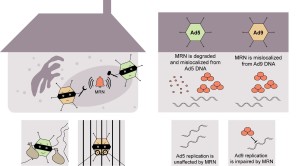
Left: Metaphorical summary. Multiple adenoviruses target MRN, but some are still impaired for viral replication, while others evade detection and inhibitory effects. Right: The well-studied Ad5 serotype degrades and alters subcellular localization of MRN to overcome inhibition of viral replication by MRN. Ad9 also alters subcellular localization of MRN. However, Ad9 replication is impaired by MRN, demonstrating that Ad9 is unable to overcome MRN completely.
Introducing the authors

Neha J. Pancholi, Cell and Molecular Biology Graduate Program, University of Pennsylvania Perelman School of Medicine
About the Research
Serotype-specific restriction of wild-type adenoviruses by the cellular Mre11-Rad50-Nbs1 complex
Virology, Volume 518, May 2018, Pages 221-231