
Regulation of the human papillomavirus type 16 late promoter by E7 and the cell cycle
Read the full article on ScienceDirect.
Human papillomaviruses (HPVs) cause cervical and several other cancers. The viral protein E7 forces cells to divide and is critical for cervical cancer development, but what E7 does in the normal, benign viral life cycle is not clear. E7 binds to and manipulates many cellular factors, some of which are involved in opposing cellular processes. Which of these many interactions is important to the virus is not known. The HPV16 late promoter is activated when cells differentiate and it drives expression of viral late proteins.
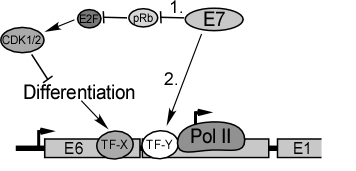
Because cell division generally disrupts cellular differentiation, we decided to test the idea that E7 expression would inhibit late promoter activation. Unexpectedly, we found that that rather than inhibiting the promoter, E7 was able to activate it. We thought that the ability of E7 to force cells to divide could be responsible for promoter activation, but we found instead that cellular factors activated by E7 that promote cell division, such as cyclin dependent kinases and E2F transcription factors, actually inhibited promoter activity.
Although the mechanisms by which E7 activates the late promoter remain unknown, our results suggest a new role for E7 in the viral life cycle in addition to its ability to promote cell division. These results also show that HPV uses E7 to take advantage of a complex interaction between cell division and differentiation during its life cycle, which may shed light on how the interaction is disrupted during cancer development.
Introducing the authors


Department of Microbiology and Immunology, Louisiana State University Health Sciences Center (Twitter: @Micro_Immuno)
About the research
Regulation of the human papillomavirus type 16 late promoter by E7 and the cell cycle
Virology, Volume 443, Issue 1, date 2013, Pages 11-19
Jason M. Bodily, Christine Hennigan, Gary A. Wrobel, Cynthia M. Rodriguez
Read the full article on ScienceDirect.